
Patient engagement companies play a pivotal role in the future of healthcare. As the industry shifts towards value-based care, pharmaceutical firms, biotech innovators, and digital health startups are realizing that clinical efficacy is no longer enough. You need adoption.
However, after speaking with over 100 psychiatrists and hundreds of health tech founders, I’ve noticed a recurring pattern. Everyone assumes they understand the patient. Usually, they don't.
Most organizations spend their energy talking to investors, other companies, and medical professionals. They assume that what the patient needs (medically) is the same as what the patient wants (emotionally).
From my own lived experience, I know these are two very different stories. Bridging that gap is the difference between a product that sits on a shelf and a solution that changes lives.
Before we look at how to engage, it is important to define the landscape. Patient engagement companies act as the bridge between healthcare organizations and the people they serve.
Traditionally, their role covers the lifecycle of a therapeutic product:
The goal is to improve outcomes by aligning solutions with patient behaviors. But while most companies rely on data and clinical proxies, the most effective engagement comes from a deeper source: lived experience.
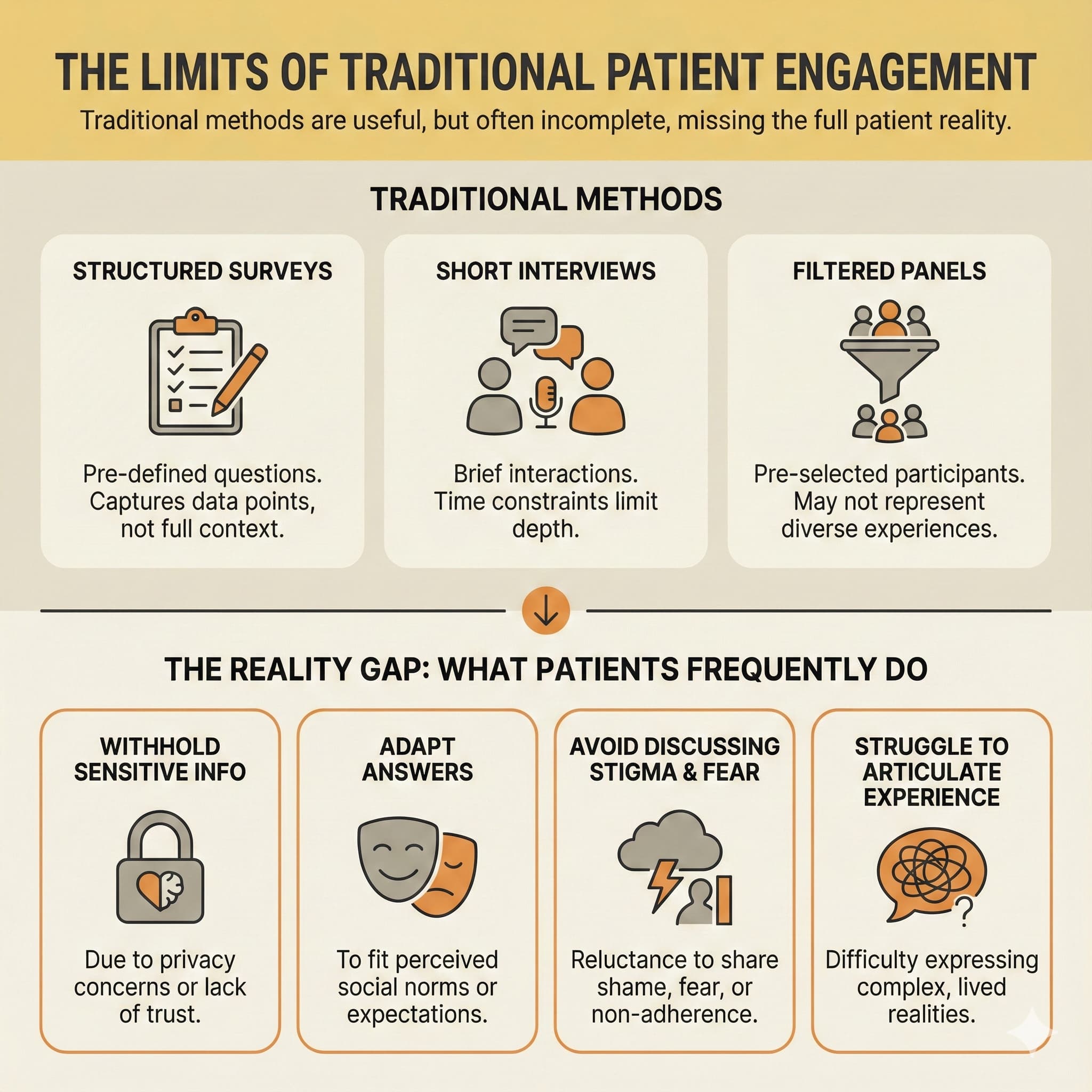
We work in an industry obsessed with rationality. But when a patient is diagnosed, rationality is the first thing to leave the room.
To share a bit of my story: I am Bipolar. When I was first diagnosed, I wasn’t rational. I felt terrified one day, relieved the next, and completely lost throughout. I was looking for a path and a solution, but I didn't know who to trust. I couldn't find people who spoke to my fear and doubt; I only found professionals offering logical "solutions" to an emotional problem.
This is where traditional patient engagement often fails. It relies on "Clinician Insight"—the rational view of the disease. It lacks "Patient Insight"—the emotional reality of the illness.
At HopeStage, we operate differently. We are a unique hybrid in the landscape of patient engagement companies.
We don't just study the patient; we are the patient. Because we have deep, established trust with this massive community, we can uncover the "blind spots" that traditional agencies miss.
Our goal is to take you From Great Science to Real Adoption. We do this through a three-step process designed to align your clinical value with patient reality.
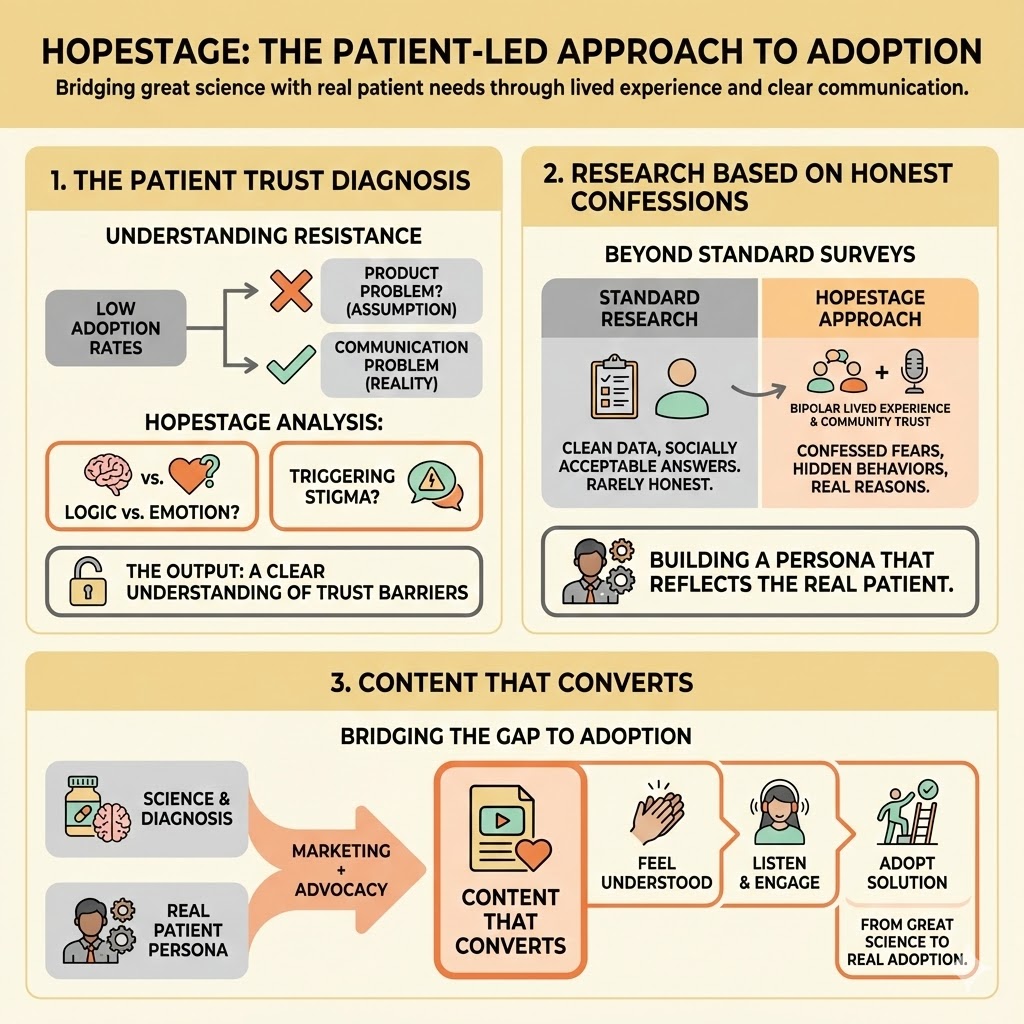
Before you can drive adoption, you must understand resistance. Most companies look at low adoption rates and assume the product is the problem. Often, it is the communication.
We analyze your current positioning to understand exactly why a patient wouldn't adopt your solution.
Standard patient engagement companies use surveys run by researchers. The data is often "clean," but it is rarely honest. Patients adapt their answers to be socially acceptable.
Because I am Bipolar and have built a relationship with thousands of users through my podcast, the dynamic is different. They don't just give me feedback; they confess their fears. They tell me why they secretly stopped taking a medication or why they deleted an app after three days.
We use this deep qualitative and quantitative research to build a persona that reflects the real patient.
Once we understand the diagnosis and the persona, we bridge the gap. We help you create content and strategies that attract patients and move them through your funnel.
This is where our marketing background merges with advocacy. We don't just educate the patient; we make them feel understood. When a patient feels understood, they listen. And when they listen, they adopt.
Working with patient-led engagement partners isn't just an ethical checklist—it is a strategic necessity.
I know that as a leader in healthcare or digital health, your calendar is full. You don't need another generic introduction. That is why I approach our first conversation differently.
My promise to you is simple: If you book a time with me, I will prepare for it.
Before we meet, I will personally review your website, your public-facing materials, and your current patient communication strategy. I will look at it through the lens of a patient, someone with lived experience who is deciding whether to trust you or click away.
When we get on the call, I will share:
I am not just offering a meeting; I am offering a fresh, patient-led perspective on your business.


