The problem
Interested patients drop off before screening.

 CADET recruitment proposal
CADET does not only need more reach. It needs fewer interested patients dropping out before screening.
A fixed-fee, three-week sprint to make the inquiry-to-screening path clearer, safer, and easier to act on.

Interested patients drop off before screening.
Three weeks to audit the funnel, interview lived-experience users, and rewrite the journey.
A recruitment pack ready for Deakin review, ethics approval, and activation.
The current challenge is not only reach. Interested people can see an ad, submit an inquiry, and still disengage before the research team reaches them. In depression, answering a call, reading a long email, or completing one more form can become too hard.
The sprint is built around that exact gap: make the next step feel clearer, safer, and easier before a person drops out of the process.
The core sprint lasts three weeks, with a fixed fee, fixed timeline, and extra work scoped separately before it starts.
No new ad, email, page, clip, or message goes live before the required Deakin ethics approval pathway.
The focus is the practical leak between interest and screening: anxiety, low energy, missed calls, unclear messages, and trust.
The proposal is built around the constraints Deakin has already identified.
The sprint focuses on the interest-to-screening gap: ads, inquiry forms, follow-up messages, call flow, and trust signals before screening.
We make the next step feel lighter, safer, and easier to complete, especially when answering a call, reading a long email, or completing another form feels too hard.
The sprint is fixed at three weeks, with clear deliverables, approval points, and no automatic ongoing commitment.
The sprint is designed to give Deakin an immediately usable recruitment improvement pack that can move through the appropriate ethics and review pathway.
Review current ads, study pages, forms, email and SMS follow-up, call flow, and available recruitment data. Identify the points where interested people disengage before screening.
Run lived-experience interviews and extract the exact language, fears, questions, and trust signals that matter to people living with bipolar and depressive episodes.
Create the message bank, ad concepts, follow-up improvements, podcast repurposing plan, channel priorities, and final 30-minute readout.
The output is a practical recruitment pack, not a theoretical strategy document. It is designed for ethics review, implementation, and clear decision-making.
By the end of the sprint, Deakin should have:
HopeStage has already recorded a podcast conversation with Professor Michael Berk. As part of the sprint, we can prepare an ethics-compliant repurposing plan that turns this existing expert conversation into patient-friendly recruitment content, if approved by Deakin.
The goal is not to use academic authority as advertising, but to translate trusted research expertise into clear, safe, accessible explanations for people considering the CADET pathway.

The work turns recruitment friction into a practical pack Deakin can review, approve, and activate through the right channels.
A practical map of where interested people hesitate, disappear, or need a lighter next step before screening.
Ad, email, SMS, and social message angles written in plain language and prepared for the right approval route.
Recruitment concepts, interview-backed questions, and approved-channel ideas that the CADET team can activate after handover.
A short final presentation showing what changed, what to test next, and what should stay out of scope.
HopeStage supports recruitment communication. Deakin remains responsible for the study, ethics pathway, consent, screening, eligibility, safety, and clinical decisions. The sprint also respects the limits already identified in prior discussions: no participant testimonials during the trial, no unapproved-site advertising, and no patient-facing claims outside approved material.
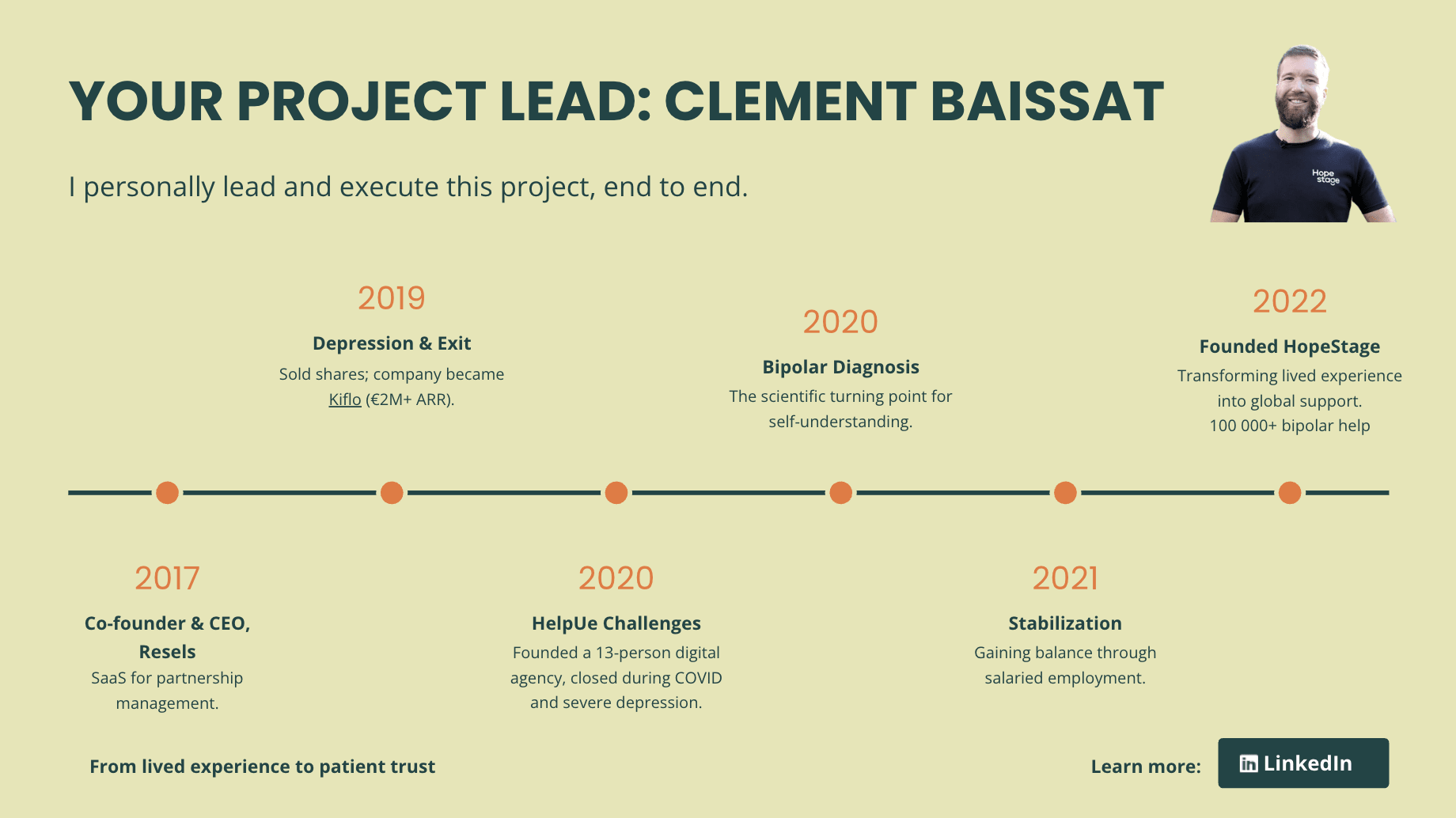
I’m Clément Baissat, founder of HopeStage, and I live with bipolarity. HopeStage brings the missing bridge between strong science and the daily reality of people who may be eligible but exhausted, anxious, or unsure whether they deserve support.
HopeStage’s role is not to bypass research governance, but to prepare patient-facing language and recruitment materials that are easier for Deakin to review, adapt, and submit through the appropriate ethics pathway.
People with lived experience are experts, not just testimonials.
HopeStage supported Alcediag, a French precision psychiatry diagnostics company, with a patient-led insight and adoption project for myEDIT-B, a blood test designed to help differentiate depression from bipolar.
The work translated lived experience into decision-ready strategy: interviews, segmentation, patient language, positioning, and funnel logic. This is the same kind of bridge CADET needs between scientific rigor and patient action.
To complete the sprint in three weeks, Deakin provides:
These boundaries are designed to keep the sprint easy to approve, safe for participants, and realistic for the Deakin team. This is intentionally not a broad marketing retainer. It is a contained recruitment improvement sprint with clear deliverables, approval boundaries, and a fixed end point.
Core sprint: AUD 9,500 ex GST fixed fee for three weeks. The sprint ends after the final readout and delivery of the recruitment pack.
Payment terms: 50% upfront, 50% on delivery.
After the sprint is delivered, Deakin can choose a lighter monthly optimisation loop with a fixed retainer and a variable recruitment pathway support fee if ongoing support is useful.
If Deakin needs a smaller committee approval pathway, the sprint can be split into smaller components before signature. No component starts until scope, timeline, and approval requirements are explicit.
Larger ad production, media buying, extra interviews, or independent ethics submissions are scoped separately before work begins.
After the three-week sprint is delivered, Deakin can choose to continue with a lighter monthly optimisation loop. This is optional, approved month by month, and only starts after the core sprint is complete.
Optional monthly optimisation loop: AUD 2,500 ex GST/month, plus a variable recruitment support fee for each participant who enters the approved trial pathway. The variable fee is agreed in advance with Deakin and only applies within the ethics-approved recruitment process. Anything beyond these caps is separately scoped before work begins.
The variable fee is not linked to clinical eligibility, randomisation, treatment outcome, or any promise that a person will be accepted into the study. It only relates to recruitment pathway support for people who progress through Deakin’s approved process.
One interview per month, where useful, to keep recruitment language grounded in patient reality.
One concise memo showing what is working, what is creating friction, and what should be tested next.
A lighter capped set of approved-channel content or message assets built from interviews and performance signals.
One monthly call to review the memo, agree priorities, and avoid uncontrolled scope expansion.
No. This is a fixed-scope sprint to improve patient trust, messaging, content, and the inquiry-to-screening pathway. HopeStage does not guarantee enrolment numbers or make eligibility decisions.
No. Deakin and the study sites retain all medical, screening, eligibility, consent, and clinical responsibilities.
All patient-facing materials are prepared for Deakin ethics review before use. If an independent ethics pathway is needed, HopeStage can help coordinate with Bellberry or another appropriate review body as a separate agreed item.
The sprint ends. Deakin receives the deliverables, recommendations, and optional next-step choices. Any monthly optimisation loop, variable recruitment support fee, or continued recruitment support is separately approved, time-boxed, and kept within Deakin’s approved process.
This proposal is designed to support the scheduled review discussion: confirm the sprint boundaries, ethics pathway, available recruitment data, and which CADET materials can be reviewed during week one.